Most of the billing horror stories I hear are about Claude Code. Is Codex by OpenAI safer?
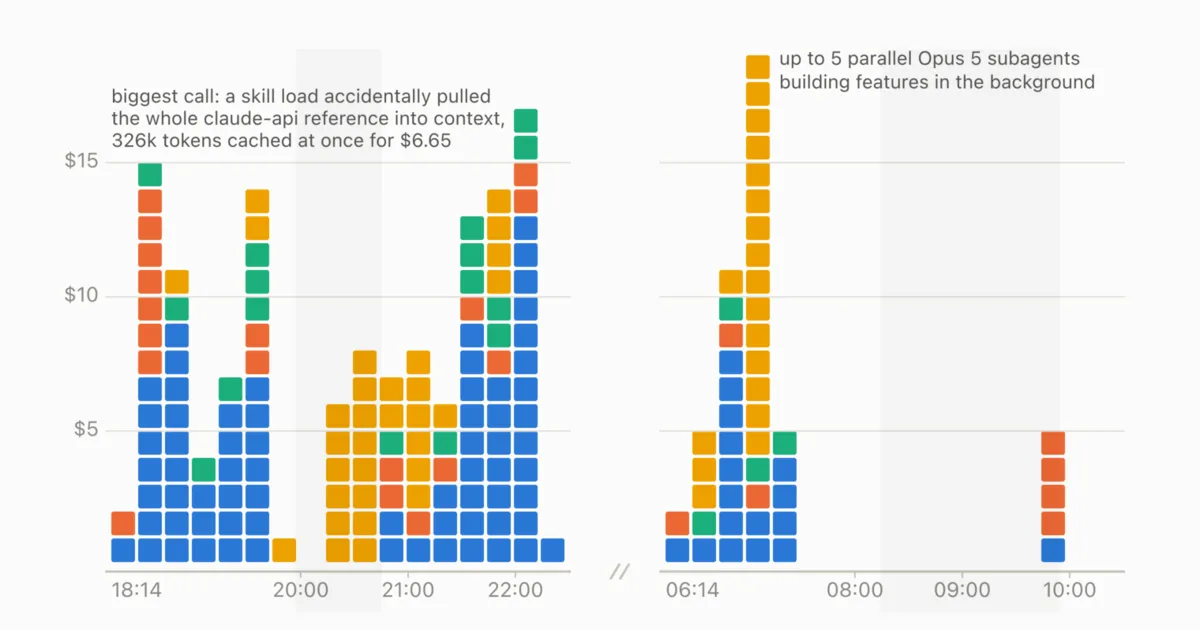
I decided to put it to the test with real money. At Quesma, we signed up for OpenAI Business ChatGPT & Codex ($25/seat/month), which comes with some usage included, and allowed $270 of overflow on top. One typical PR used it all within 24 hours and left my weekly limit exhausted.
TL;DR:
- Stay on a seat-based 5x, 20x, or Business Premium plan as long as you can.
- The 20x-plus seat-versus-token price difference is real; experiments confirm it.
- OpenAI’s and Anthropic’s billing models closely match.
On the plus side, Codex with default settings does a pretty good job with auto-compactions, avoiding the long-context cache misses Claude Code is known for. It also doesn’t charge extra for caching, so tokens are cheaper overall.
On the downside, it is super easy to land in fast mode. I accidentally confirmed it and ran the first half of this change at double rates: $110 of the $283 above was the fast-mode premium. Even worse, it is impossible to disable fast mode across an entire OpenAI Business organization, while Claude requires organizational approval before anyone can turn it on.
OpenAI ChatGPT & Codex seat-based pricing is an order of magnitude cheaper than paying per token
The $283 day above fits comfortably inside a $200/month subscription. I ship a similar PR every workday on Claude Code Max 20x, and teammates do the same on ChatGPT Pro 20x.
My experience matched the SemiAnalysis post, which found that OpenAI’s $200/month plan delivered up to $14,000/month in tokens.
That multiple seems even bigger: 70x cheaper for seats versus token equivalents, compared to 40x for Claude. They’re directionally the same. SemiAnalysis’s June 2026 benchmark might have been impacted by 5 extra limit resets granted by Tibo from OpenAI.
From OpenAI experiments to mirroring Anthropic’s pricing model
OpenAI’s pricing reflects its history with Anthropic.
OpenAI was first to market with an LLM generating usable programming code with its Codex model in August 2021. Some early OpenAI employees wanted to go all-in on that direction, which sparked conflict, so they left the mothership and started Anthropic with the belief that the path to AGI is through agentic coding.
So while Anthropic was focused on enterprise and coding, OpenAI pursued many research bets, with ChatGPT being the jackpot.
As a pioneer, Codex initially got per-message pricing, which was later retired in favor of tokens. Chats generated a consistent number of tokens, so seat-based subscriptions made more sense.
However, the rapid acceleration of Anthropic’s growth, starting with Claude Code and Claude Opus 4 in May 2025, brought validation along with controversy, reflected in 2 customer class-action suits over pricing (Kahn v. Anthropic and Pascual v. Anthropic).
OpenAI was forced to re-evaluate priorities and match its offerings. So far it has managed to avoid public cases against its pricing.
On August 25, 2026, with the release of Premium Seats for ChatGPT Business ($125/month), it matched the offering.
| Tier | OpenAI (Codex) | Anthropic (Claude Code) |
|---|---|---|
| Budget | ChatGPT Go ($8/month), ChatGPT Plus ($20/month) | Claude Pro ($20/month) |
| Power individual | ChatGPT Pro 5x / 20x ($100 / $200/month) | Claude Max 5x / 20x ($100 / $200/month) |
| Team standard | Business, $25/seat/month, 2-200 seats | Team, $25/seat/month ($20 annual), 2-150 seats |
| Team premium | Business Premium, $125/seat/month | Team Premium, $125/seat/month |
| Enterprise | Custom seat price + shared credit pool at API list rates | $20/seat + usage billed at API list rates |
The major difference is their budget offering. Because OpenAI leverages its massive ChatGPT customer base, its budget plans are more usable with weekly-only limits, so you can be amazed for a few hours by agentic coding before having to wait for a week or upgrade. Though there are concerns about whether the lack of a 5-hour limit will stay or is an OpenAI A/B experiment.
In contrast, Claude Pro’s 5-hour limit is often unusable for even a basic PR in a big repository.
In August 2026, OpenAI started experimenting with paid resets: $8 on Plus, $40 on Pro 5x, and $80 on Pro 20x. A way to keep working without committing to an upgrade.
Recommendations for getting the best enterprise OpenAI deal
You can follow most of the advice from my previous post on Claude Code enterprise pricing:
-
For training and exploration, expense individual coding plans, as they are the most cost-effective. Today, the best way to master agentic coding is to use it a lot, and offering it as a perk for a limited time is a great way to take advantage of the massive subsidy.
-
Later, try to stay on Team plans as long as possible. You can use multiple plans or providers to delay upgrading.
-
Upgrade to Enterprise only if you have to, and make sure you have solid cost monitoring and controls in place.
On top of that, OpenAI is way more aggressive about offering discounts to existing Anthropic enterprise customers, such as 2 months free. Though the public offer by Sam Altman in May 2026 ended, I have heard rumors that you can still get similar deals.
OpenAI also offers discounts through third-party channels: they want to capture more market share, so for a limited time you can get 50% cheaper tokens through OpenRouter and Vercel than from OpenAI itself (Hacker News discussion).
They even discounted their frontier GPT-5.6 Sol model by about 20% while I was writing this post. Competition is great for customers.
Summary
Public perception differs a lot, but Codex’s billing model is very similar to Claude Code’s, with small tweaks in favor of OpenAI. Horror stories with Codex are possible. It is not immune to the same problems: overages and a painful enterprise upsell.
For many companies, the premium ($125/month) seat-based plans are a reasonably good default for engineers. Enterprises need to be careful with token plans and overages.
Using many vendors at the same time is common and a good hedge. In the Pragmatic Engineer survey, 70% of engineers use 2 to 4 AI tools simultaneously, and only 15% stick to a single one. We often hear about teams running Claude Team, ChatGPT Business, and Cursor in tandem, while still experimenting with OpenCode and OpenRouter. Companies often have a small group of pioneer AI employees who get access to everything and who set reasonable defaults for the others.
Standardization seems risky and expensive. Hedging, with rapid adjustments, is a good strategy for now.